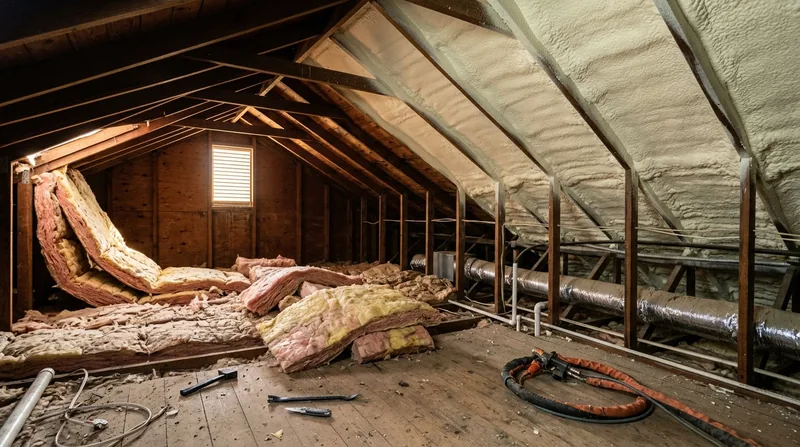




Savannah's older housing stock, from the century-old frame homes in Ardsley Park to the mid-century brick ranches across Midtown, was built with insulation materials that lose their battle against the Lowcountry's humidity long before summer ends. Attics in Pooler and Richmond Hill bake through extended cooling seasons, vented crawl spaces pull in damp coastal air, and rim and band joists in raised-foundation homes become thermal weak points that drive energy bills higher every year. Insulation replacement and re-insulation removes failed or degraded material and installs new spray foam or batt insulation sized for Chatham, Bryan, and Effingham county homes in climate zone 2A. When aging insulation can no longer hold back moisture or maintain an air barrier, we pull it and replace it with the right product for your home's construction type and your cooling season. Our work is measured, permitted where required, and backed by a clear estimate with R-value and thickness specifications before any work begins.
Why Insulation Replacement Matters in Savannah's Hot, Humid Climate
Savannah homes face a unique insulation challenge: moisture-driven inward through walls and foundations most of the year, coupled with a cooling season that stretches from late spring through early fall. Vented attics and crawl spaces pull in humid air off the Savannah River and from surrounding marshlands, and old fiberglass batts or loose-fill material compress over time, losing R-value and allowing air to move freely through the envelope. Energy bills track the length of the cooling season more closely than winter heating, which means a degraded attic or crawl space insulation system costs you money every single day from May through September. Spray foam and new batt insulation create an air barrier that fiberglass alone cannot, stopping both conductive heat loss and the infiltration of humid outside air.
- Old fiberglass batts settle and compress, leaving gaps and voids that let conditioned air escape and hot, humid air leak inward.
- Spray foam seals rim and band joists, attic rim boards, and foundation walls where air leakage is most concentrated in older Savannah homes.
- New insulation installed at the correct thickness and R-value for Chatham County homes reduces cooling load and stabilizes interior humidity year-round.
- Removing failed insulation before replacement prevents mold growth on sheathing and framing, which thrives in the Lowcountry's warm, damp environment.
- A sealed, insulated attic or crawl space reduces the work your air conditioning system must do, extending equipment life and lowering repair costs.
Homes in Savannah, Pooler, Richmond Hill, and surrounding areas see the fastest payback on insulation replacement when the old material is no longer performing.
Key info: Savannah's energy code requires attic insulation to meet R-38 in most residential construction, and vented attics must maintain clear airflow to soffits and ridge vents. The building official at your city or county sets the minimum, and we size replacement insulation to meet or exceed that standard. Verify requirements with your local building department before starting work.
For more on how spray foam seals and insulates in one step, see our attic spray foam insulation service.
How Insulation Replacement Works: Our Process in Savannah Homes
Insulation replacement begins with a thorough inspection of your attic, crawl space, or wall cavities to assess what is currently installed, where it has failed, and what removal and disposal will cost. We measure the area, document the existing R-value and thickness, and identify any moisture, contamination, or air leakage points that need attention before new insulation goes in. Once you approve the estimate, we remove the old material, haul it away, seal obvious air leaks with caulk or foam, and then install new insulation to the thickness and R-value specified in your written estimate. The entire process is scheduled to minimize disruption to your home, and we protect finished areas and HVAC equipment during removal and installation.
- We inspect the existing insulation and document its type, depth, condition, and any visible air leaks or moisture damage.
- We measure square footage and calculate the R-value required for your home's construction and Chatham County energy code compliance.
- We remove old fiberglass, cellulose, or failed foam, bag it, and haul it to an approved disposal site.
- We seal rim joists, band boards, ductwork penetrations, and other air leak sources with spray foam or caulk.
- We install new insulation, spray foam, or batt material at the specified thickness, ensuring complete coverage with no voids or compression.
- We clean up and dispose of all debris on site, leaving your attic or crawl space ready for the next 20 to 30 years of service.
From start to finish, a typical attic re-insulation in a Savannah mid-century ranch takes one to two days, depending on the size and the amount of old material to remove.
Example: A 1,200 square-foot attic in Richmond Hill with 4 inches of settled fiberglass and no air sealing requires removal, cleaning, rim joist sealing, and new open-cell or closed-cell spray foam to R-38 depth. The job runs two to three days and includes disposal of the old material. See our insulation removal service for details on disposal and recycling options.
Insulation Replacement Methods for Savannah Homes
| Approach | Description | Best For |
|---|---|---|
| Closed-Cell Spray Foam | High-density foam with R-6.5 per inch, moisture-resistant, creates a continuous air and vapor barrier in one application. | Crawl spaces, rim and band joists, vented attics that need moisture control, and metal buildings where condensation is a risk. |
| Open-Cell Spray Foam | Lower-density foam with R-3.6 per inch, breathable, more cost-effective, provides air sealing and sound dampening in one pass. | Attics in Savannah and Pooler homes where condensation risk is low, rooms over garages, and interior wall cavities in retrofit work. |
| Fiberglass Batts (New) | Blanket insulation cut to fit between joists or rafters, R-3.2 to R-3.8 per inch depending on density, requires air sealing separately. | Simple attic top-ups where existing structure is sound, budget-conscious owners, and homes where spray foam odor or cure time is a concern. |
| Blown-In Cellulose or Fiberglass | Loose-fill material installed with pneumatic equipment to fill cavities and attic floors, settles over time, requires air sealing separately. | Attics with irregular framing, existing voids, and retrofit work where access is limited and a lower upfront cost is the priority. |
Insulation Replacement and Re-Insulation Cost in Savannah: What to Expect
Insulation replacement cost in Savannah depends on the square footage of the space, the type of insulation being removed, the new material you choose, and the labor required for air sealing and disposal. A straightforward attic re-insulation with old fiberglass removal and new spray foam or batt insulation typically starts at $2,800 for a smaller home and rises with attic size, complexity, and the amount of old material to haul away. Crawl space replacement involving rim and band joist sealing plus closed-cell foam on the walls runs higher because of the moisture control requirement and the labor-intensive nature of working in a confined space. Getting two or three estimates from local contractors gives you the best sense of what the job will cost and what each company includes in their scope.
- Attic size is the primary driver: a 1,000 square-foot attic costs less to insulate than a 2,000 square-foot attic in a sprawling Pooler or Richmond Hill home.
- The amount and type of old insulation affects removal and disposal costs, especially if fiberglass or cellulose is heavily settled or contaminated.
- Spray foam costs more per board foot than blown-in batts or fiberglass, but seals air leaks in one step and requires no separate air sealing work.
- Crawl space work costs more because of confined space access, moisture control requirements, and the need for closed-cell foam on foundation walls.
- Permits and inspections, if required by your local building department, are included in the estimate and do not add a separate fee.
For a detailed breakdown of pricing across different project types and sizes in Savannah, visit our full pricing overview.
Insulation Replacement and Re-Insulation Near Me: What to Look for When Hiring a Spray Foam Contractor in Savannah
Hiring the right contractor for insulation replacement is as important as the material itself. The spray foam and insulation trade includes both local independent shops and national franchises, and the difference shows in how carefully a contractor plans the job, manages the cure process, and stands behind the work after it is finished. A reputable local contractor will provide a written estimate with R-value and thickness specifications, explain the removal and disposal process, and walk you through what to expect during the installation. Before you book, verify that the contractor is fully insured, ask for references from recent Savannah-area jobs, and understand what permits or inspections your city or county requires.
- Request a written estimate that specifies the R-value, thickness in inches, square footage, and the cost of removal and disposal separately.
- Ask whether the contractor carries full insurance and is willing to provide a certificate of insurance before work begins.
- Verify that the contractor understands local building code for your city or county and can explain what permits or inspections apply to your address.
- Check references from at least two recent Savannah or Pooler homes, and ask specifically about the contractor's communication and cleanup after the job.
- Confirm the re-entry window after spray foam cure (typically 24 to 48 hours) and whether mechanical ventilation will be used during installation.
- Ask about the warranty on workmanship and whether the manufacturer offers a system warranty on the insulation material itself.
A contractor who refuses to provide a written estimate, promises immediate re-entry to a sprayed attic, or quotes a price far below market without an inspection is a red flag. For a free, no-obligation estimate from a local Savannah contractor, contact us today or call (912) 483-1976.
Learn more about closed-cell spray foam and open-cell spray foam to understand which product best fits your home's needs.
Insulation Replacement & Re-Insulation in Savannah: Pricing Guide
| Service | Price | Details |
|---|---|---|
| Attic Re-Insulation (Removal + New Spray Foam) | Starting at $2,800 | Includes old fiberglass removal, disposal, air sealing, and new open-cell or closed-cell foam to R-38 specification for 1,000 sq ft attic |
| Crawl Space Insulation Replacement | Starting at $3,500 | Includes removal of old material, rim and band joist sealing with closed-cell foam, and wall insulation for moisture control in vented crawl space |
| Blown-In Batt or Cellulose Top-Up (No Removal) | Starting at $1,200 | For homes with sound existing insulation needing only depth increase, includes air sealing and new material to reach R-38 or higher in attic |
| Wall Cavity Retrofit (Injection Foam) | Starting at $2,200 | Includes drilling, injection foam installation, and patching for exterior wall cavities in older Savannah homes without interior demolition required |
| Complex or Large-Scale Replacement | On estimate | Multi-story homes, extensive removal, metal buildings, or jobs requiring structural assessment scheduled for on-site inspection before pricing |
| Free Estimate and Site Visit | No charge | Response within 24 hours at (912) 483-1976, includes R-value and thickness specification, no obligation to book, travel included in Savannah area |
Indicative pricing, the exact cost depends on square footage, finish, and site access. Free personalized estimate within 24h at (912) 483-1976.


