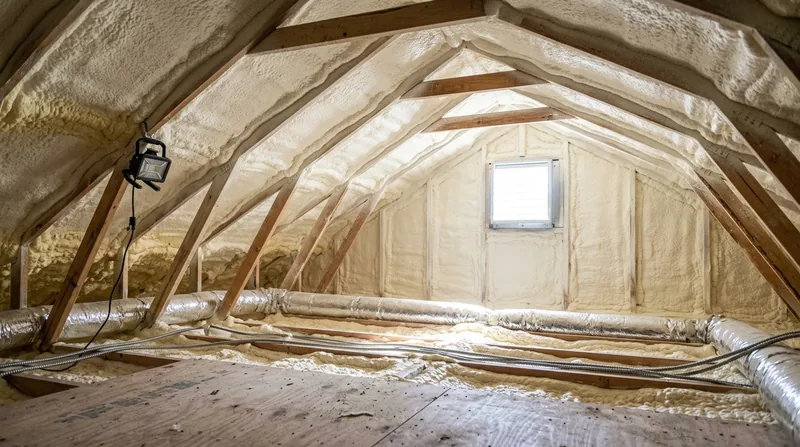




Attic spray foam insulation in Savannah cuts heat gain fast during the long, humid cooling season that dominates the Lowcountry climate. Savannah attics bake under the summer sun, with interior temperatures climbing well past 130 degrees Fahrenheit while conditioned air escapes through gaps in the roof deck, top plates, and around penetrations. Spray foam seals those leaks and insulates the rafter cavities in a single pass, stopping heat from entering and keeping conditioned air from bleeding out. Whether you own a century-old frame house in Ardsley Park shaded by live oaks, a mid-century brick ranch in Midtown, or a new subdivision home pushing toward Pooler and Richmond Hill, the cooling load is the same: long and relentless. We seal and insulate attics across Savannah, Pooler, Richmond Hill, Garden City, and the surrounding Chatham, Bryan, and Effingham counties, and we do it right. Call us at (912) 483-1976 for a free estimate with R-value and thickness specs.
Why Attic Spray Foam Insulation Matters in Savannah's Hot, Humid Climate
Savannah sits in climate zone 2A, where the cooling season stretches from May through October and often beyond. The Lowcountry's high humidity means moisture is always trying to move inward through walls and attics, especially in older homes with vented crawl spaces and attics. A vented attic pulls in damp coastal air off the Savannah River and surrounding marshes, and that humid air carries sensible heat that your air conditioning has to fight all day. Spray foam on the roof deck stops that inward moisture drive and cuts the sensible cooling load by sealing every gap where hot, humid air can leak into the conditioned space below.
- Sealed roof decks reduce the temperature swing in rooms directly under the attic, especially bedrooms and bonus rooms over garages in newer subdivisions.
- Spray foam stops air infiltration at the top plate, rim board, and around ductwork penetrations, which are the biggest energy leaks in most Savannah attics.
- Closed cell foam provides a moisture barrier and structural strength in older frame houses where rafter spacing is irregular and ventilation routes are blocked by tree growth.
- Unvented attics allow HVAC ducts to run in conditioned space, a major efficiency gain in homes where the ductwork is currently exposed to 130-degree attic temperatures.
The result is lower cooling bills and more consistent comfort from room to room, especially in the afternoon when solar heat gain peaks on south and west-facing roofs.
Key info: Attic ventilation, ignition barriers, and thermal barriers are governed by the energy code and building official at your address. Always verify what applies at your location by contacting your city or county building department. Your local building department can tell you what applies at your address.
For more details on how closed cell and open cell foams compare, see our closed cell spray foam insulation page.
How We Insulate Savannah Attics: From Sealing to Spray
Every attic job starts with a walk-through to identify air leaks, measure rafter depth, check for moisture or prior damage, and understand what code applies at your address. We look at the roof deck, top plates, rim boards, ductwork penetrations, and any gaps around wiring or plumbing. Then we seal the biggest leaks with foam and caulk, and we spray the rafter cavities to the specified R-value and thickness. The entire process takes one to three days depending on attic size and complexity, and we provide written specs with R-value and thickness called out.
- We inspect the attic for moisture, mold, or prior insulation failure before we spray anything.
- We seal all air leaks at the top plate, rim board, ductwork penetrations, and around wiring and plumbing.
- We spray closed cell or open cell foam to the thickness and R-value specified in the estimate, using controlled passes and proper drum temperature and ratio.
- We provide mechanical ventilation during cure and a re-entry window of twenty-four to forty-eight hours before the space is safe for normal use.
- We clean up all equipment, dispose of any prior insulation per local code, and leave your attic ready for storage or mechanical equipment.
This approach works for new construction, retrofit jobs in older homes, and top-ups of existing insulation that has settled or failed.
Local example: A 1970s brick ranch in Midtown Savannah had a vented attic with R-19 fiberglass that had settled to R-8 in the rafter cavities. We removed the old insulation, sealed the top plate and soffit penetrations, and sprayed closed cell foam to R-30 over 2.5 inches. The homeowner's cooling bills dropped by 18 percent in the first summer, and the attic stayed dry through the humid season.
For information on removing old insulation before we spray, see our insulation removal page.
Attic Spray Foam Insulation Methods: Closed Cell vs. Open Cell
| Approach | Description | Best for |
|---|---|---|
| Closed Cell Spray Foam | High-density foam (3.5 to 4 lbs per cubic foot) that hardens to a rigid shell. Provides R-6 to R-7 per inch, moisture barrier, and structural bracing. Requires a thermal barrier or ignition barrier per code. | Older frame houses with moisture concerns, unvented attics, and retrofit jobs where thickness is limited by rafter depth. |
| Open Cell Spray Foam | Low-density foam (0.5 to 0.6 lbs per cubic foot) that expands and stays semi-soft. Provides R-3.5 to R-3.6 per inch and allows drying if moisture enters. Requires a thermal barrier per code. | New construction and retrofit attics where moisture is not a concern and budget is a priority. Also used for sound dampening in attics near living spaces. |
| Sealed Roof Deck (Unvented Attic) | Spray foam applied directly to the underside of the roof sheathing, creating a sealed, unvented attic. Allows HVAC ducts to run in conditioned space and eliminates attic humidity. | New builds and major retrofits where roof deck is exposed or accessible. Reduces cooling load and allows ductwork relocation. |
| Rafter Cavity Fill | Spray foam applied to the underside of rafters, filling the cavity between rafter and interior finish. Works with vented or unvented attics depending on code and design. | Retrofit jobs in existing homes where the roof deck is not accessible. Provides R-value without removing roof sheathing. |
Attic Spray Foam Insulation Cost in Savannah: What to Expect
Attic spray foam insulation in Savannah typically starts at $1.50 per square foot for open cell foam in a straightforward rafter cavity fill, and runs $2.50 to $4.00 per square foot for closed cell foam or sealed roof decks. The actual cost depends on the size of the attic, access for equipment, rafter depth, whether you need insulation removal first, and the R-value you want to achieve. A 1,500-square-foot attic with open cell foam to R-30 might cost $2,250 to $3,000; the same attic with closed cell foam to R-30 or higher might cost $3,750 to $6,000. Sealed roof decks and unvented attics cost more because the foam is applied to the roof deck itself and requires careful attention to code-compliant thermal barriers and ignition barriers.
The biggest cost drivers are attic size, the depth of rafter cavities (which limits how much foam you can spray), whether old insulation has to be removed, and access for the spray rig. Older homes in Ardsley Park and newer subdivisions in Pooler and Richmond Hill often have different rafter spacing and attic configurations, so each job is priced on site. We provide written estimates with R-value and thickness specified, so you know exactly what you are paying for.
The best way to understand cost is to get two or three estimates from local contractors. This lets you compare R-value, thickness, materials, and workmanship warranty. We offer free estimates with no obligation, and we respond within 24 hours. Call (912) 483-1976 or visit our pricing page for a detailed breakdown of what affects the final cost.
What to Look for When Hiring a Spray Foam Insulation Contractor Near Me in Savannah
Hiring a spray foam contractor is a decision that affects your home's comfort and energy bills for years. The right contractor will provide a detailed estimate with R-value and thickness, explain what code requires at your address, carry full insurance, and stand behind the work with a clear warranty. The wrong contractor will quote a price with no specs, promise immediate re-entry, offer insurance that cannot be verified, and disappear when the smell does not go away or the foam settles.
Here is what to verify before you sign:
- Ask for a written estimate that specifies R-value, foam thickness in inches, and the type of foam (closed cell or open cell).
- Verify that the contractor carries full insurance and ask for a certificate of insurance naming your address as an additional insured.
- Check references from recent jobs in Savannah, Pooler, Richmond Hill, or Garden City, and ask specifically about cure time, smell, and any issues after the job was done.
- Understand what permits apply at your address by asking your city or county building department, and verify that the contractor knows the local code and thermal barrier rules.
- Get at least two estimates so you can compare R-value, thickness, materials, and price per square foot.
- Ask about the re-entry window (typically twenty-four to forty-eight hours) and what mechanical ventilation is used during cure.
- Verify that the contractor will not spray over wet, contaminated, or leaking substrates, and will address moisture issues before foam is applied.
A local contractor with a local address, local insurance, and local references is your strongest position. Avoid out-of-state crews in trailers, national franchises with no local accountability, and any estimate without R-value and thickness written down. If you have questions about any contractor, including us, call us at (912) 483-1976 or visit our contact page to get a second opinion.
Attic Spray Foam Insulation in Savannah: Pricing Guide
| Service | Price | Details |
|---|---|---|
| Open Cell Spray Foam, Attic Rafter Cavity | Starting at $1.50/sq ft | Includes sealing top plate and penetrations, spray to R-20 to R-30, mechanical ventilation, re-entry window twenty-four to forty-eight hours |
| Closed Cell Spray Foam, Attic Rafter Cavity | Starting at $2.50/sq ft | Includes air sealing, spray to R-20 to R-30 over two to three inches, thermal barrier, higher density and moisture resistance than open cell |
| Sealed Roof Deck (Unvented Attic) | Starting at $3.50/sq ft | Spray applied to underside of roof sheathing, includes all air sealing and thermal barriers, allows ductwork relocation into conditioned space |
| Insulation Removal and Replacement | On estimate | Cost depends on volume of old insulation, disposal fees, and attic access; we price removal and spray together as a single job |
| Travel and Estimate | Included in Savannah and surrounding areas; Free estimate | No mileage fee for Savannah, Pooler, Richmond Hill, Garden City, and nearby Chatham, Bryan, Effingham counties; response within 24 hours |
Indicative pricing, the exact cost depends on square footage, finish, and site access. Free personalized estimate within 24h at (912) 483-1976.


