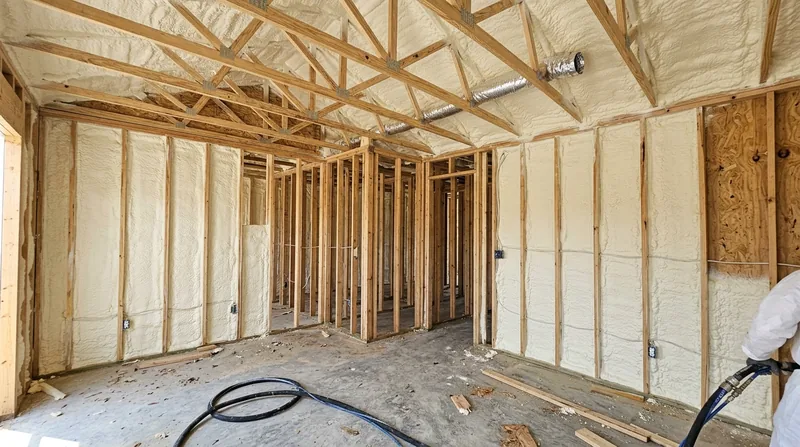




Commercial & New Construction Spray Foam in Savannah insulates new builds and commercial projects across Chatham, Bryan and Effingham counties before drywall closes the walls and mechanical systems go in. New construction in the Lowcountry runs year-round, and builders here know that spray foam on roof decks, walls and crawl spaces before the next phase locks in the thermal envelope and controls moisture from day one. Whether you are framing a subdivision pushing toward Pooler and Richmond Hill, closing up a commercial shell in Garden City, or insulating crawl spaces and band joists on new stick-framed homes in Savannah proper, the window is narrow and the installation must be right the first time. We spray closed cell and open cell foam on new construction projects, seal all penetrations and air barriers, and move fast so your schedule stays on track.
Why New Construction Spray Foam Matters in Savannah's Building Boom
New residential and commercial construction across Greater Savannah has accelerated into Bryan and Effingham counties, and builders are waking up to moisture control. Savannah sits in climate zone 2A with hot, humid summers and mild winters, which means moisture-driven inward pressure through walls and foundations most of the year. Vented attics and open crawl spaces on new builds pull in damp coastal air off the Savannah River, and that humidity loads the structure before occupancy. Spray foam on roof decks and in crawl spaces stops that infiltration before it starts, and the air seal around it keeps conditioned air from leaking into unconditioned space.
- We spray closed cell foam on roof decks to create a sealed, conditioned attic that keeps summer heat and humidity out of the living space.
- We foam crawl space walls and band joists on new construction to stop moisture ingress and protect rim board and floor framing from the ground up.
- We seal all wall penetrations and rim transitions so the air barrier is complete before drywall closes the cavity.
- We work to the builder's schedule and coordinate with framing, electrical and HVAC so your project flow is not disrupted.
Builders who spray foam new construction in Savannah report tighter homes, lower call-back rates for comfort complaints, and faster drying times after the wet trades finish.
Key info: New construction spray foam is installed before drywall, electrical trim-out and HVAC rough-in, which means the job must be scheduled tight with the framing crew. Permits and thermal barrier requirements vary by city across Savannah, Pooler, Richmond Hill and Garden City, so your local building department can tell you what applies at your address and defer to the local building department.
For more on how moisture control works in sealed attics and crawl spaces, see our page on Crawl Space Spray Foam Insulation.
How We Install Commercial & New Construction Spray Foam in Savannah
New construction spray foam is a precision job because the substrate is clean, the schedule is tight, and the installer must stay coordinated with the builder's framing and mechanical trades. We start with a site walk-through to confirm roof deck dimensions, crawl space access, wall cavity depth and any electrical or plumbing rough-in that affects spray zones. We then schedule the foam application after framing is complete but before drywall, HVAC ductwork or electrical trim-out begins. Once the foam cures, we verify thickness and R-value against the specifications in the estimate, and the builder moves to the next phase.
- We inspect the framing and substrate to confirm it is clean, dry and ready for foam.
- We set up mechanical ventilation and establish a re-entry perimeter so the building can remain unoccupied during the cure window.
- We spray foam to the specified thickness in controlled passes, holding the manufacturer ratio and drum temperature throughout.
- We allow the foam to cure for twenty-four to forty-eight hours before drywall, HVAC or electrical work resumes.
- We photograph the installation and provide the builder with R-value and thickness documentation for the permit file.
This step-by-step approach means no surprises on the job site and no delays to the builder's schedule.
Example: A new 12-unit townhome development in Richmond Hill requires closed cell foam on the roof deck and open cell foam in the crawl space to meet the energy code. We schedule the spray after framing, before drywall. The job takes two days, the foam cures overnight, and the builder's drywall crew starts the next morning on schedule.
Learn more about the technical differences between closed cell and open cell foam on our Closed Cell Spray Foam Insulation page.
Commercial & New Construction Spray Foam Methods and Approaches
| Approach | Description | Best For |
|---|---|---|
| Closed Cell Roof Deck | High-density foam sprayed 1.5 to 2 inches thick on the underside of the roof sheathing to create a conditioned, sealed attic. | New construction in hot, humid climates where moisture control and air sealing are priority. |
| Open Cell Crawl Space | Low-density foam sprayed 3.5 to 4 inches on crawl space walls and rim joists to insulate and air-seal without vapor barrier. | New construction in moderate climates where vapor permeability is acceptable and cost is a factor. |
| Closed Cell Wall Cavity | High-density foam sprayed 1.5 to 2 inches in wall cavities before drywall to seal all penetrations and air leaks. | New stick-framed residential and light commercial construction where air sealing and moisture control are required. |
| Commercial Metal Building | Closed cell foam sprayed on the underside of metal roof and wall panels to prevent condensation and insulate the shell. | New commercial shells, warehouses and agricultural buildings where condensation on steel is the dominant failure mode. |
Each method is chosen based on the building type, the local climate and the builder's energy code compliance target.
Commercial & New Construction Spray Foam Cost in Savannah: What to Expect
New construction spray foam is priced by the board foot installed, which means the cost depends on the roof deck area, crawl space square footage, wall cavity volume and the foam type (closed cell or open cell). A typical new residential project in Savannah or Pooler runs from a few hundred board feet on a small townhome to several thousand on a full-size subdivision lot. Commercial jobs vary widely depending on the building footprint and the scope of sealing. The best starting point is a free commercial estimate on site, where we measure the space, confirm the substrate and building code, and give you a fixed price with R-value and thickness spelled out.
Several factors move the cost up or down. Roof deck area is the primary driver: a 1,500-square-foot sealed attic on a single-story home is a smaller job than a two-story colonial with dormers and a complex roof line. Crawl space depth and access affect the spray setup and labor time. Wall cavity fill depends on whether the foam is going into new open framing or being injected into existing cavities. Proximity to utilities, occupied spaces or sensitive equipment may require additional ventilation or containment. We always provide a detailed estimate with the thickness in inches, the R-value per inch, and the total board feet and cost, so you know exactly what you are paying for.
For a complete pricing overview and to understand the cost factors for your specific project, visit our Pricing page.
Hiring a Commercial & New Construction Spray Foam Contractor Near Me in Savannah
Finding the right spray foam contractor for your new construction project means verifying that the installer has insurance, understands the local building code, and can deliver on time and on spec. Start by asking any contractor for proof of full insurance coverage and a certificate of insurance naming your project. Request at least two or three estimates so you can compare the R-value, thickness, board feet and price across contractors. Ask the contractor about their experience with new construction in your city or county, and ask to see examples of sealed attics or crawl spaces they have completed. Check that they understand the thermal barrier and ignition barrier rules in your local building code, because that distinction is where many generalists stumble. If your project is in an HOA or master-planned community, confirm that the contractor knows the architectural guidelines for any exterior or mechanical work.
- Verify that the contractor carries full insurance and can provide a certificate of insurance before work begins.
- Ask for multiple written estimates that spell out R-value, thickness in inches and total board feet so you can compare apples to apples.
- Request references from recent new construction projects in Savannah, Pooler or Richmond Hill so you can ask about their experience and schedule reliability.
- Confirm that the contractor understands the local building code at your address and defers to the building department on permits and thermal barriers.
- Ask about the cure time and re-entry window so you know when your drywall or mechanical crew can resume work.
A contractor who provides a detailed estimate with no surprises and coordinates cleanly with your builder's schedule is worth the call.
Ready to get started? Contact us for a free commercial estimate at (912) 483-1976, or fill out our online form and we will respond within 24 hours.
Commercial & New Construction Spray Foam in Savannah: Pricing Guide
| Service | Price | Details |
|---|---|---|
| Free Commercial Estimate | Free | On-site measurement and code review for new construction projects, no obligation to book, response within 24 hours |
| New Construction Spray Foam (Residential) | Starting at $0.60 per board foot | Closed cell or open cell foam installed on roof decks, crawl spaces and walls before drywall, price varies by thickness and foam type |
| Commercial Building Insulation | Starting at $0.55 per board foot | Metal buildings, warehouses and commercial shells; closed cell foam on roof and wall panels to prevent condensation and meet energy code |
| Large-Scale or Complex New Construction | On estimate | Multi-unit developments, mixed-use projects or buildings with unique geometry or substrate conditions require site inspection before pricing |
| Travel and Setup | Included | No separate mileage fee or travel charge for projects in Savannah, Pooler, Richmond Hill, Garden City and surrounding service areas |
Indicative pricing, the exact cost depends on square footage, finish, and site access. Free personalized estimate within 24h at (912) 483-1976.


