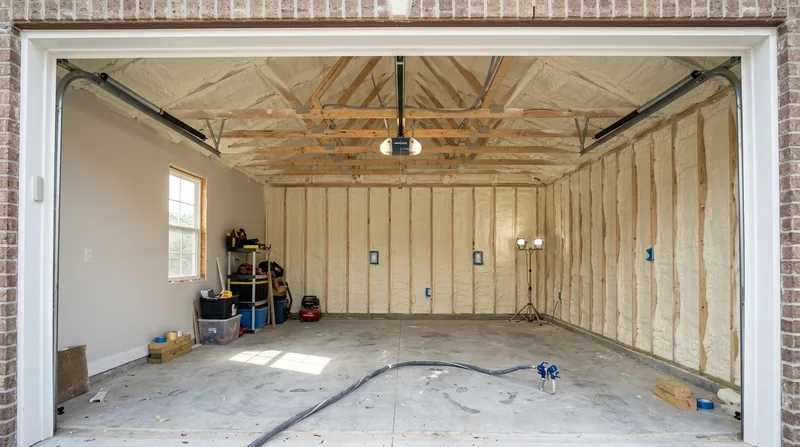




Garage spray foam insulation in Savannah transforms uninsulated garage spaces into climate-controlled rooms and protects living areas above from heat transfer through unfinished ceilings. In Pooler and Richmond Hill subdivisions, garages bake through the long cooling season without insulation, allowing heat to radiate upward into bedrooms and bonus rooms while the garage itself becomes unusable in summer. Savannah's climate zone 2A means your cooling season stretches from late April through October, and a garage ceiling with no barrier lets that baked air transfer directly into the conditioned space above. We spray foam garage ceilings and walls to seal air leaks, stop radiant heat transfer, and keep the space usable year-round. Whether your garage is attached to a brick ranch in Midtown or a newer stick-framed home in Richmond Hill, foam insulation cuts the load on your air conditioning and stabilizes temperatures on both sides of that ceiling. Learn more about our insulation services across Savannah.
Why Garage Insulation Matters in Savannah's Hot, Long Cooling Season
Uninsulated garages in Savannah act as heat collectors. The roof and walls absorb solar radiation all day, and without foam insulation, that heat conducts straight through into the rooms above. A bedroom over an uninsulated garage in Pooler or Richmond Hill can run 8 to 12 degrees hotter than the same room elsewhere in the house, forcing your air conditioner to work harder and longer. Spray foam seals the air leaks that fiberglass misses and creates a continuous thermal barrier, so the garage becomes a buffer zone instead of a heat pump.
- Stops heat transfer through the garage ceiling into rooms above, reducing cooling demand on long summer days.
- Seals air leaks around electrical outlets, sill plates, and rim joists that vented attics and blown-in insulation cannot reach.
- Creates a usable workshop, storage, or recreation space that stays cool enough to work in without air conditioning running full blast.
- Protects HVAC ducts and refrigerant lines if they run through the garage, keeping them at closer to room temperature.
- Works in attached and detached garages, whether the space is vented or closed, and over concrete slabs or crawl spaces.
The result is lower cooling costs, more comfortable rooms above, and a garage that does not become a dead zone from June through September.
Local example: A 400-square-foot garage ceiling in a Richmond Hill subdivision, sprayed with 2 inches of closed-cell foam, typically reduces the cooling load by 15 to 25 percent on the second floor, with payback in 3 to 5 years of lower electric bills. The same garage insulated with fiberglass batts leaves air leaks around the perimeter and at rim joists, so the real-world savings run 8 to 12 percent.
For more on how foam handles the moisture challenges of Savannah's humid climate, see our guide to air sealing and moisture control in Savannah homes.
How We Insulate Your Garage: The Process in Savannah
Garage spray foam insulation begins with an on-site inspection to measure the ceiling and walls, check for existing insulation or obstructions, and identify electrical or mechanical systems that need protection. We then prepare the space by moving vehicles and securing any items in the garage, and we post ventilation signs during the cure period. The crew applies foam in controlled passes, maintaining the manufacturer's ratio and drum temperature, and we run mechanical ventilation for 24 to 48 hours after spraying to ensure proper cure before re-entry.
- Schedule a free on-site estimate by calling (912) 483-1976 or visiting our contact page. We measure the space, confirm the R-value and thickness you need, and provide a written estimate with no obligation.
- Prepare the garage by removing vehicles, tools, and stored items; we protect electrical outlets and fixtures with fire-rated covers before spraying begins.
- Our crew applies foam in two or three passes, building to the specified thickness and R-value, maintaining ratio and temperature throughout.
- We run exhaust fans and keep the space ventilated for 24 to 48 hours while the foam cures; we post re-entry signs and provide a re-entry window before you use the garage normally.
- Once cured, the foam is hard, non-settling, and ready for paint or a thermal barrier coat if required by code.
The entire job typically takes one day for a standard attached garage, with cure time handled passively overnight.
Savannah example: A two-car garage attached to a brick ranch in Ardsley Park, measuring 400 square feet of ceiling, is sprayed with 2 inches of closed-cell foam (R-13 to R-14) on a Tuesday morning. The crew finishes by early afternoon, we ventilate through Wednesday, and the homeowner can park and use the space normally by Thursday. Total installed cost starts at $1,200, with the final price depending on existing insulation and the R-value target.
Garage Insulation Methods: Closed-Cell vs. Open-Cell Foam
| Approach | Description | Best for |
|---|---|---|
| Closed-Cell Spray Foam | High-density foam (1.5 to 2.0 pounds per cubic foot) that cures to a hard, rigid shell. R-value is approximately R-6 to R-7 per inch. Provides an air barrier and vapor barrier in one pass. | Garages where moisture control and structural rigidity matter, and where 2 to 3 inches of foam delivers the R-value you need without thick buildup. |
| Open-Cell Spray Foam | Lower-density foam (0.4 to 0.5 pounds per cubic foot) that cures soft and spongy. R-value is approximately R-3.5 to R-3.8 per inch. Requires 5 to 8 inches to reach R-20, and requires a vapor barrier on the warm side. | Budget-conscious jobs where you have vertical wall space and want to minimize material cost. Not recommended for garage ceilings in Savannah's humid climate without a secondary vapor barrier. |
| Foam + Blown-In Insulation Hybrid | Spray 1 to 2 inches of closed-cell foam to seal air leaks and create a vapor barrier, then top up with blown-in fiberglass or cellulose to reach target R-value at lower cost. | Large ceilings where you need both the air-sealing power of foam and the bulk of blown-in insulation, and where budget is a factor. |
| Foam Walls Only | Spray the garage walls to R-10 or R-15 while leaving the ceiling uninsulated or using a simpler approach (blown-in or batts). Reduces heat gain on the walls and improves comfort in the space. | Detached garages or workshops where you want to keep the space usable but do not need to condition the air above it, and where the focus is on wall comfort. |
For garages in Savannah, closed-cell foam on the ceiling is the most common choice because Savannah's humidity means moisture moves inward through walls and attics most of the year, and closed-cell creates a vapor barrier in one pass. Two inches of closed-cell delivers R-13 to R-14, enough to cut the heat transfer significantly without requiring thick buildup.
Garage Spray Foam Insulation Cost in Savannah: What to Expect
Garage spray foam insulation in Savannah starts at $1,200 for a standard two-car garage ceiling, measured at the site and quoted with a specific R-value and thickness. The final cost depends on the size of the ceiling, the depth of existing insulation (if any), the R-value target, whether you are insulating walls as well, and access for our spray rig. A small single-car garage ceiling runs $800 to $1,200. A larger three-car garage or one with walls insulated as well runs $1,800 to $2,600. Garages with difficult access, existing insulation to remove, or structural obstacles that require extra prep work may run higher.
The biggest factor in cost is R-value and thickness. Two inches of closed-cell foam (R-13 to R-14) costs less than three inches (R-19 to R-21), but the extra inch delivers noticeably better cooling performance in Savannah's long summer. Most homeowners in Richmond Hill and Pooler choose R-15 to R-20 on the ceiling as the sweet spot between performance and cost. We provide a detailed pricing breakdown on our pricing page, and we always give you a written estimate with the R-value, thickness, and square footage spelled out before any work begins.
Getting two or three estimates from local contractors is the smart move. Compare the R-value and thickness quoted, not just the dollar amount. A low estimate without a stated R-value and thickness is a red flag. We include a mechanical ventilation plan and a 24 to 48-hour re-entry window in every estimate, and we stand behind the work with a one-year workmanship warranty.
Garage Spray Foam Insulation Near Me: What Savannah Homeowners Should Know Before Hiring
Hiring a spray foam insulation contractor in Savannah or nearby areas like Pooler, Richmond Hill, and Garden City requires checking three things: insurance, estimates with written R-value specs, and references from recent garage or attic jobs. Spray foam work is not licensed as a separate trade in Georgia, but your contractor must carry full liability and workers compensation insurance, and you should ask to see a current certificate before any crew shows up. A legitimate estimate includes the square footage, the R-value per inch, the thickness in inches, the total R-value of the installed system, and the price. If a contractor gives you a price without those specs, walk away.
- Ask for proof of insurance (general liability and workers compensation) and verify it is current and covers spray foam work.
- Request a written estimate that states the R-value, thickness, square footage, and total installed R-value, not just a dollar amount.
- Call at least two references from garage or attic jobs completed in the last 12 months, and ask about the cure time, ventilation, and any issues after the work was done.
- Confirm whether the contractor will handle any permits or notifications required by your city or HOA, and ask how they manage the 24 to 48-hour ventilation and re-entry period.
- Verify that the contractor uses a licensed HVAC or mechanical ventilation specialist to run exhaust fans during cure, not just an open door or window.
- Ask whether the contractor has experience with your specific garage type (attached to a house, detached, metal-framed, slab-on-grade, or over a crawl space).
Rig-and-run crews from out of state, national franchises with no local presence, and contractors who promise immediate re-entry without ventilation are the three biggest red flags in the spray foam market. A local shop with a local address, local plates, and local references is your safest choice. Contact us for a free estimate, and we will walk you through the process step by step.
Garage Spray Foam Insulation in Savannah: Pricing Guide
| Service | Price | Details |
|---|---|---|
| Single-car garage ceiling | Starting at $800 | Two inches of closed-cell foam, approximately 150 to 200 square feet, R-13 to R-14 installed |
| Two-car garage ceiling | Starting at $1,200 | Two inches of closed-cell foam, approximately 350 to 450 square feet, R-13 to R-14 installed |
| Three-car garage or garage plus walls | Starting at $1,800 | Ceiling and perimeter walls, three inches of closed-cell foam, R-19 to R-21, approximately 600 to 800 square feet |
| Existing insulation removal and replacement | On estimate | Removal, disposal, and new foam installation cost depends on insulation type, depth, and contamination level |
| Travel and estimate | Free | No charge for on-site measurement and written estimate, included in Savannah and surrounding service areas |
Indicative pricing, the exact cost depends on square footage, finish, and site access. Free personalized estimate within 24h at (912) 483-1976.


